

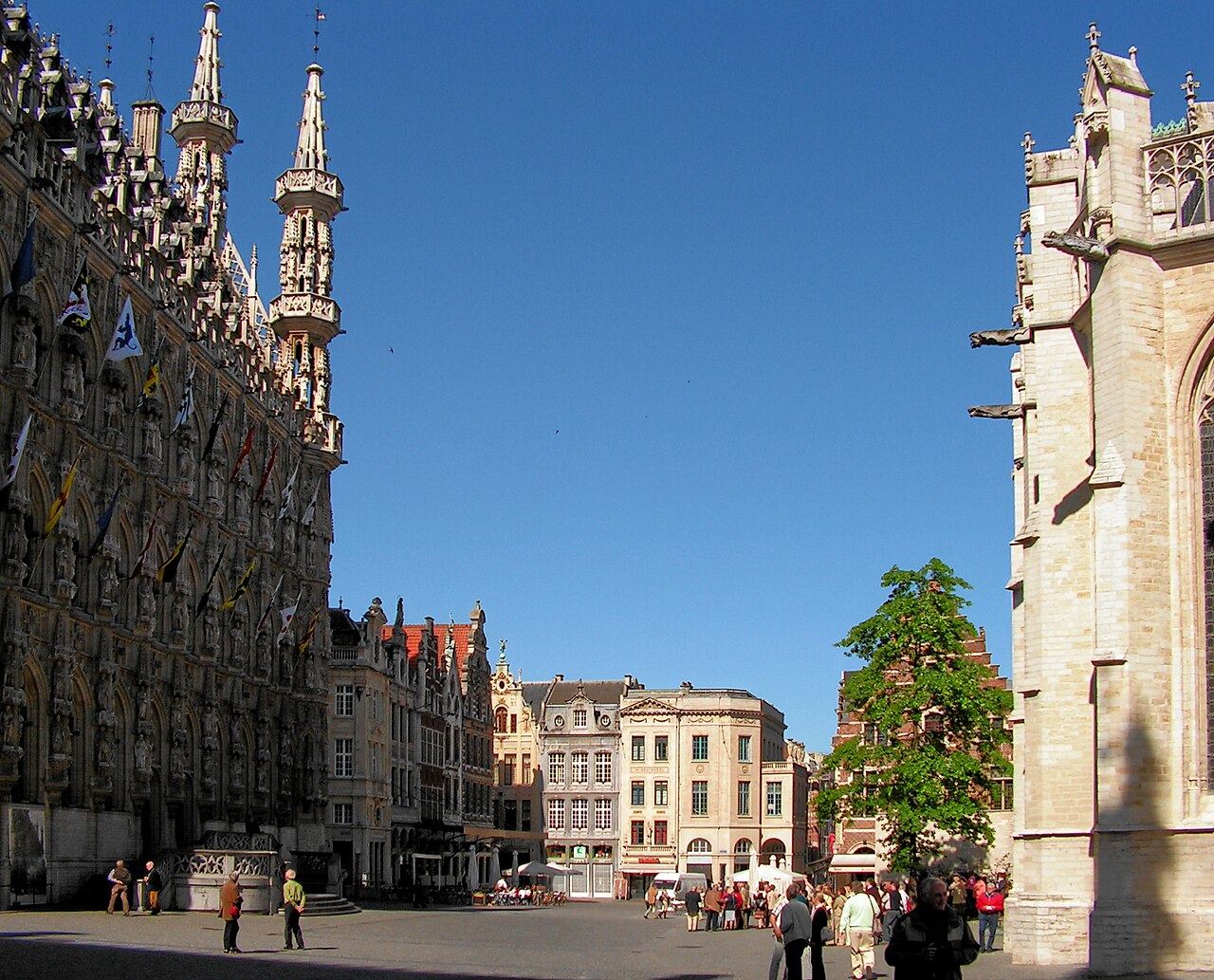
Leuven's Grote Markt. Photo: Snowdog, public domain (Wikimedia Commons).
I was delighted to visit KU Leuven to take part in the Mini-Symposium on Evolutionary Genomics, hosted by the Department of Biology. It was a great excuse to talk about two of my favourite things — reproducible pipelines and genome evolution — with a room full of evolutionary genomicists.
The talk
My talk, “Extensive genome rearrangements in the haplodiploids: a novel pipeline for syntenic break”, looked at how chromosomes have been reshuffled across the haplodiploid insects, and how we can detect and quantify those rearrangements at scale.
The engine behind that work is Eco-Flow/synteny — a Nextflow pipeline, built to nf-core standards, that compares gene macrosynteny between chromosome-level genome assemblies. Give it genomes and their annotations and it handles the rest, producing comparable, publication-ready synteny analyses across many species.
Spreading the Nextflow word
Alongside the science, a big part of the visit was introducing Nextflow and the nf-core community to researchers who hadn’t used them before. Pipelines like our synteny workflow are a great way to show why reproducible, portable workflows matter: the same analysis runs on a laptop, an HPC, or the cloud, and anyone can reproduce your results. Conversations like these are exactly how we grow the community.
The rest of the programme
The symposium also featured two talks I was sorry to miss: Emilia Santos (University of Cambridge) on the genomic and developmental basis of colour-pattern evolution, and Sozos Michaelides (Concordia University) on lake trout adaptations in a large postglacial lake. Both sounded fascinating — a real shame our schedules didn’t line up, but a good excuse to catch them another time.
Huge thanks to Tom Wenseleers for the invitation and the warm welcome to KU Leuven.
Curious about the synteny pipeline? Take a look at Eco-Flow/synteny, or get in touch if you’d like help running it on your own genomes.